The Combine
One Flew Over the Cuckoo's NestThe Combine is Chief Bromden’s name for the expansive system that, in his perception, makes institutions and ordinary social life serve a common purpose: adjusting people until they fit. The hospital is its factory, Nurse Ratched its formidable local authority, and the regimented ward a model of the order the system seeks to impose beyond its walls. The idea gives Chief Bromden’s account of bureaucracy and conformity a machinery of its own, while the patients’ resistance tests whether that machinery can ever be stopped.
Nature and Reach
Chief Bromden describes the Combine as much larger than any single nurse or hospital. Nurse Ratched has spent years adjusting the ward, but she cannot remain there constantly; her work connects with others who, in his understanding, are adjusting the outside world as well. He sees her not as the system’s creator but as a high-ranking official within it. The organization therefore reaches across the boundary between hospital and society: the ward concentrates processes that Chief Bromden recognizes elsewhere.
The narrator’s account mixes institutional observation with a vision of invisible technical control. He imagines Nurse Ratched at the center of a web of fine wires, tracking each connection and sending the current needed to produce a desired result. His explanation draws on his past training as an electrician’s assistant and his college exposure to electronics. The image makes dispersed authority appear at once coordinated and intimate: the wires are too small for others to see, but, to him, they explain how a person’s behavior can be managed without a single visible command.
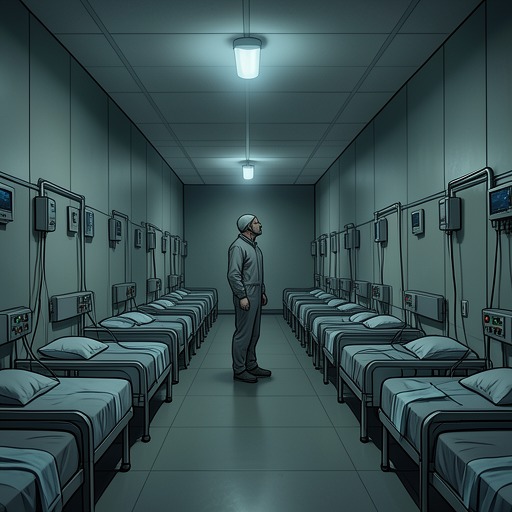
In this vision, the system’s ideal is precision, tidiness, and an unbreakable schedule. Its most chilling endpoint is a ward populated only by compliant chronic patients, immobilized in wheelchairs and connected by tubes. This imagined perfection is not simply efficient administration. It is a world in which individual differences have been eliminated by reducing people to manageable bodies. Chief Bromden’s mechanical imagery thus presents order as a form of coercion, even when the institution describes its purpose as treatment.
The Ward as Factory and Control Network
The ward turns the Combine’s larger project into daily practice. Patients watch one another, and a man’s unguarded admission can become material for the ward logbook: another patient may leave the table, go to the book by the Nurses’ Station, and record what he heard. Nurse Ratched presents the records as therapeutically useful, while Chief Bromden understands them as evidence that could help send someone to the Main Building for reconditioning. Surveillance is not confined to staff observation; the patients themselves can be drawn into maintaining the system.
The organization also sorts patients according to their perceived prospects. Across from the Acutes are the Chronics, whom Chief Bromden describes as people the hospital no longer expects to repair. Some can still walk, while others use wheelchairs or have been reduced to what he calls vegetables. His account treats this classification as more than a neutral medical distinction: the chronic patients are the finished product of a system that labels some people repairable and others irreparably flawed. Their placement across the room makes that hierarchy visible within the ward.
Routine completes the mechanism. Notes made during the day are typed and fed into a machine behind the steel door at the rear of the Nurses’ Station. The machine returns daily cards punched with patterns of square holes; inserting the properly dated card sets the ward’s operations in motion. At six-thirty the lights come on, the Acutes are roused, and patients are put to work on cleaning tasks. The day’s sequence makes individual time subordinate to an institutional schedule, while labor and treatment become parts of one managed routine.
The clock can intensify that control. Nurse Ratched can change its speed with a dial, making the hands race and the picture-screen windows flash through morning, noon, and night. Under accelerated time, the men struggle through repeated rounds of shaving, meals, appointments, and medication, with scarcely enough time to rest before the next apparent day begins. The effect is not merely that the ward is busy: the authority to manipulate the clock makes even the patients’ sense of time answer to institutional power.
Chief Bromden calls the hospital a factory because it processes people who are regarded as mistakes made in neighborhoods, schools, and churches. A patient who returns to society as an adjusted, functioning member becomes a successful product in Nurse Ratched’s imagined order. But a new admission threatens the factory precisely because he may disrupt its smooth operation. The system’s language of repair therefore carries a contradiction: helping someone fit into the existing world can also mean treating nonconformity itself as a defect.
Outside Society and Inherited Pressure
Chief Bromden sees the same logic beyond the hospital. On the coast, he notices trains depositing men in mirrored suits and machined hats, then describes identical houses strung across hills outside a town. Five thousand children in matching clothes play crack-the-whip on crushed gravel beside the development. The line repeatedly throws the same child against a fence; the other children return to homes so alike that they sometimes enter the wrong house without anyone noticing. The scene connects mass-produced buildings and standardized schooling to the Combine’s larger pattern: conformity can pass unnoticed, while the person injured by the pattern remains conspicuous and unable to laugh.
His family history gives that abstraction a particular cost. Chief Bromden recounts that the Combine worked on his father for years, pressing him toward inspected houses and taking the falls, while pressure also came from within the tribe and from violence in town. His father once asked what could be paid for the way a man lived and what a man was, but after the sale of the land he was left too diminished and drunk to guide those who came to him with checks. Chief Bromden identifies his mother’s influence as part of the pressure that made his father too small to continue fighting. The story makes adjustment a process that can reach into family and community life, not just the hospital.
Chief Bromden also imagines the system as installing machinery in people from childhood, especially once it recognizes that a child might grow into someone powerful or independent. That language turns social conformity into a long process rather than a single act of force: habits, institutions, and expectations do the work over time. The image is the narrator’s way of making an otherwise difficult-to-see pressure legible, and it links his father’s history to the standardized world he observes around him.
Resistance and the Limits of Control
McMurphy initially appears to the Acutes as a man the Combine has not captured. Chief Bromden speculates that his restless life—moving from place to place, working, gambling, and traveling—may have kept the system from fixing its controls on him. He is vulnerable, but his mobility has made him a difficult target. For a time, his natural ease and full-throated laughter make Chief Bromden believe that the system will not be able to manufacture him into the shape Nurse Ratched wants.
The ward’s World Series dispute shows how resistance can spread through a group. McMurphy asks to move cleaning work to the evening so the patients can watch the games during the afternoon; Nurse Ratched refuses on the grounds that the schedule is delicately balanced. When McMurphy puts the television change to a vote, the first hand he sees is his own. Cheswick raises his hand too, but the patients’ hesitation makes clear how difficult public opposition has become. Later, McMurphy calls for those in favor of afternoon television to raise their hands. Chief Bromden sees the Acutes follow one after another until all twenty are standing with their hands raised, opposing not only the schedule but also Nurse Ratched’s effort to send McMurphy to the Disturbed Ward and her treatment of them over the years. A vote about television becomes a visible break in their isolation.
That solidarity does not make Nurse Ratched powerless. Chief Bromden sees her lose a local contest during a group meeting, but regards the loss as only one battle in a much larger struggle. Her authority is backed by the Combine, and, in his formulation, she can turn her own defeats into further victories if the patients are made to lose confidence or hope. The distinction prevents resistance from becoming a simple story of one contest won: the organization’s reach outlasts a particular meeting, and each act of opposition must be measured against the pressure that follows it.
The nighttime party supplies another breach. Chief Bromden realizes that he is drunk, laughing, and carrying on with the others on Nurse Ratched’s ward, a place he has regarded as the Combine’s strongest stronghold. The night has happened because the patients made it happen, like opening a window to let in fresh air. His discovery is not proof that the system has disappeared; it is evidence that its control can be interrupted and that the patients can imagine doing so again. After McMurphy’s defeat and the ward’s later upheaval, Chief Bromden runs from the hospital across the grounds and for miles toward the highway. His escape gives the possibility of refusal a concrete outcome beyond the ward.
Narrative Role and Significance
The Combine organizes the novel’s recurring contrast between machinery and selfhood. Its factory, punched cards, schedule, clock dial, wires, identical houses, and repeated uniforms make control seem both technical and ordinary. The system does not need to appear only as a visible command: it can work through records, classifications, routine, and the expectation that people will monitor themselves and one another. The ward’s treatment language gives these processes an official purpose, while Chief Bromden’s metaphors expose the cost he sees beneath that purpose.
The account remains specifically Chief Bromden’s. He presents the Combine as a national organization and describes its invisible networks with certainty, but the narrative’s machinery imagery also conveys how pervasive and overwhelming its power feels to him. His perceptions connect small ward procedures with large social patterns without reducing the two to identical settings: the hospital is a factory in his metaphor, while the standardized development and the history of his father show why he believes its logic extends outside. McMurphy’s refusal, the patients’ collective vote, the party, and Chief Bromden’s escape each unsettle the system’s apparent completeness. Together they establish the Combine as a force formidable enough to shape lives, but not so total that resistance is impossible.